
What to wear to a job interview
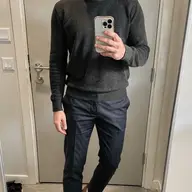
Are you already dressed for an interview? Check if it works below.
How it works
- Add a photo
- We read the look
- Get the verdict
What we look at
- Colours
- How the shades work together.
- Fit
- Whether the cuts and silhouettes work together.
- Proportions
- The balance between top and bottom halves.
- Shoes
- Whether they match the formality of the rest.
- Overall
- Whether the look holds together as one outfit.
Adults only, clothes on, your own photo. Terms
Dress one step above what people at the company wear on an ordinary day, in clothes that fit well and need no attention once you sit down. At a suit-and-tie firm that means a suit; at a business casual office, a blazer with tailored pants or a skirt; at a startup, clean chinos or dark jeans with a collared shirt or a fine knit.
Below you'll find what the research says about interview clothes (including one famous finding that didn't hold up), outfits by industry, the piece-by-piece list, what changes on video, what to leave at home and a night-before check.
The rule: one step above the everyday dress code
Interviewers don't expect you to dress as if you already work there. They expect you to look like you took the day seriously. One step dressier than the company's everyday dress code does both: it reads as effort without looking like a costume.
Find that everyday code before you choose. Look at team photos on the company's careers page and social accounts, or at what its people wear in talks and videos they've posted. Or ask the recruiter: "What do people usually wear to interviews here?" is a normal question, and the answer saves you guessing.
| If people there usually wear | Wear to the interview |
|---|---|
| Suits every day, as in banking, law and some consulting | A suit in navy or charcoal, a pressed shirt or blouse and leather shoes. A tie is still common in these fields. |
| Business casual, as in most offices | A blazer over a collared shirt, blouse or fine knit, with tailored pants or a skirt and leather shoes. Or a simple dress with a blazer. |
| Smart casual, as in many tech and creative companies | Chinos or dark, plain jeans with a collared shirt, knit polo or fine sweater, and loafers or clean leather sneakers. An unstructured blazer is optional. |
| Casual or practical clothes, as in startups, shops, kitchens and trades | The tidiest version of what the job wears: clean chinos or dark jeans, a plain shirt or knit, and clean, practical shoes. |
| A uniform or protective gear | Smart casual. Nobody expects the uniform, only that you'd look after it. |
When the invitation says "come as you are": take it at face value, then tidy it up. Casual still means clean, pressed and fitted, and a layer you can take off (an overshirt, a cardigan or an unstructured blazer) covers you if the room turns out to be dressier than you expected.
What the research says about interview clothes
First impressions form quickly. In a study at Princeton, people saw photos of faces for a tenth of a second, and their ratings of traits such as trustworthiness and competence were already close to the ratings other people gave with no time limit (Willis and Todorov, 2006).
Clothes are part of that first read, and small details register. Researchers at the University of Hertfordshire showed people photos of the same man, his face blurred, in either a made-to-measure suit or a similar off-the-peg one. After a few seconds of looking, they rated him more favorably on confidence, success and earning power in the made-to-measure suit (Howlett and colleagues, 2013). The visible difference was the cut, which is why this guide keeps saying fit, not price.
The first minutes matter, though not because of a seven-second verdict. In mock interviews, the impressions interviewers formed during the opening small talk predicted their final ratings, and even the candidates' later job offers (Barrick and colleagues, 2010). When researchers asked interviewers when they had made up their minds, the timing varied from candidate to candidate, and most decisions came minutes into the conversation rather than in its first seconds (Frieder and colleagues, 2016). Clothes help you start well. They don't decide the job.
What you wear may also change how you think, but this part of the science is shakier. In a series of experiments, people wearing formal clothes thought in broader, more abstract terms (Slepian and colleagues, 2015), and men randomly assigned to wear a suit in a mock negotiation came away with better deals than men in sweatpants (Kraus and Mendes, 2014). The most famous claim, that a doctor's lab coat sharpens attention (Adam and Galinsky, 2012), did not hold up when another team repeated the experiment with a preregistered design (Burns and colleagues, 2019). The dependable effect is how other people read your clothes, not a mental boost.
Nerves are normal, and one kind is easy to remove. Psychologists who mapped job interview anxiety found five kinds: worries about communicating, social anxiety, worries about performing, visible nervous behavior and worries about how you look (McCarthy and Goffin, 2004). Choosing and testing the outfit the day before takes the last one off the list.
Interview outfits by industry
Industries have tendencies, but the company always beats the industry: a fintech startup can dress like a startup, and a design team inside a bank can dress like a bank. Use the table as a starting point, then check it against the company's own photos.
| Industry | Usual interview outfit | Worth knowing |
|---|---|---|
| Finance, law, consulting | A suit in navy or charcoal, a white or light blue shirt or blouse, dark leather shoes, often a tie | Client-facing roles stay formal even where the office is relaxed. A plain watch and a structured bag finish it. |
| Corporate offices: HR, marketing, sales, operations | A blazer with tailored pants or a skirt, a shirt, blouse or fine knit, and leather shoes | Sales roles often go a step dressier, because you'll be meeting customers. |
| Tech and startups | Chinos or dark, plain jeans, a collared shirt, knit polo or fine sweater, and loafers or clean leather sneakers | A full suit can read as out of touch. Neat and current beats formal. |
| Creative fields: design, media, fashion, advertising | A considered outfit with one detail that shows your taste: a good jacket, an interesting knit or a well-chosen shoe | Your clothes are part of your portfolio. Keep them intentional rather than loud. |
| Healthcare, education, public sector | Business casual: tailored pants or a skirt with a shirt, blouse or knit, and a blazer for senior roles | Wear shoes you could walk a hospital corridor or a campus in. |
| Retail, hospitality, trades | Smart casual, one step tidier than what the job wears day to day | At a fashion retailer, a piece or two in the brand's style shows interest; head-to-toe merchandise looks like a uniform. |
What to wear, piece by piece
Whatever the dress code, the same checklist holds. The goal is an outfit you stop thinking about the moment you leave the house.
- Jacket: a blazer or suit jacket that buttons without pulling and lets you lift your arms. The shoulder seams should end where your shoulders do.
- Shirt, blouse or knit: a solid color or a quiet pattern, pressed, with a collar or neckline you won't need to adjust.
- Pants, skirt or dress: tailored and the right length. Skirts and dresses that reach the knee or below sit well in a chair.
- Shoes: clean, and comfortable enough to walk in for ten minutes. Leather shoes, loafers, low heels or flats; minimal leather sneakers only where the company wears them.
- Bag: one structured bag or a folder big enough for printed copies of your CV and a notebook.
- Accessories: a watch, simple jewelry and a belt as formal as your shoes. Nothing that jingles or flashes on a video call.
- Grooming: clean hair, a tidy beard if you wear one, and short, clean nails. They get noticed before any label does.
What to wear to a video interview
On a video call, the camera shows the top third of you and exaggerates a few things. Dress the whole outfit anyway: you may need to stand up, fetch something or move the laptop. Then adjust for the lens.
- Solid, mid-tone colors such as navy, gray, blue, green or burgundy read best. Bright white can glare and pure black can lose detail, depending on the camera and the light.
- Skip fine stripes, small checks and herringbone. On many cameras they shimmer into a wavy moiré pattern.
- Choose a neckline with structure. A collar, a blazer lapel or a crew-neck knit holds its shape on screen better than a soft T-shirt.
- Leave noisy jewelry and rustling fabrics for another day. The microphone picks them up.
- Test the whole setup the day before: the outfit, the background, light facing you rather than behind you, and the camera at eye level.
The one-step rule still applies. A blazer reads as clearly on a laptop screen as it does across a desk, so dress to the same step you would in person.
What not to wear to a job interview
Most interview outfit mistakes are about condition and distraction, not style. Leave these at home:
- Anything wrinkled, stained, faded, pilled or missing a button.
- Clothes that don't fit today, whatever the label says. Straining buttons and sleeves past the knuckles both read as careless.
- Brand-new shoes you haven't walked in. Blisters show on your face.
- Big logos, slogans and loud graphics. They start a conversation you didn't plan.
- Athletic wear, flip-flops and anything see-through, unless the job really is outdoors or physical.
- Anything you'll keep adjusting: a neckline that slips, a skirt that rides up, a tie that won't sit straight.
Go light on fragrance. In a nationally representative survey of US adults, 34.7% said fragranced products cause them health problems such as migraines or breathing difficulties (Steinemann, 2016). An interview room is small and the door is closed, so wear very little or none.
The night before: a ten-minute check
Settle the outfit in the evening, when there's still time to steam a shirt, polish shoes or change your mind. Then run this check:
- Try everything on together, shoes included, and sit down in it. Check that the jacket buttons, the shirt doesn't gape and the hem stays where it should.
- Check the forecast for the time you'll spend outside, and pick a coat or umbrella that suits the outfit underneath.
- Steam or iron, use a lint roller, and polish or wipe your shoes.
- Lay out everything that leaves the house with you: the bag, printed copies of your CV, a notebook, a pen and a charged phone.
- Plan to arrive ten minutes early, plus the time it takes to walk from the station or the car park in those shoes.
Another appointment after the interview? The method in what to wear today works the same way: dress for the more formal setting and plan one change.
Plan the interview outfit in Clottr
Clottr tags every item you add across roughly 19 attributes, formality among them, so you can filter your closet down to the pieces that match the company's step. Every tag is editable, so if you think a piece is dressier or more casual than its tag says, change it.
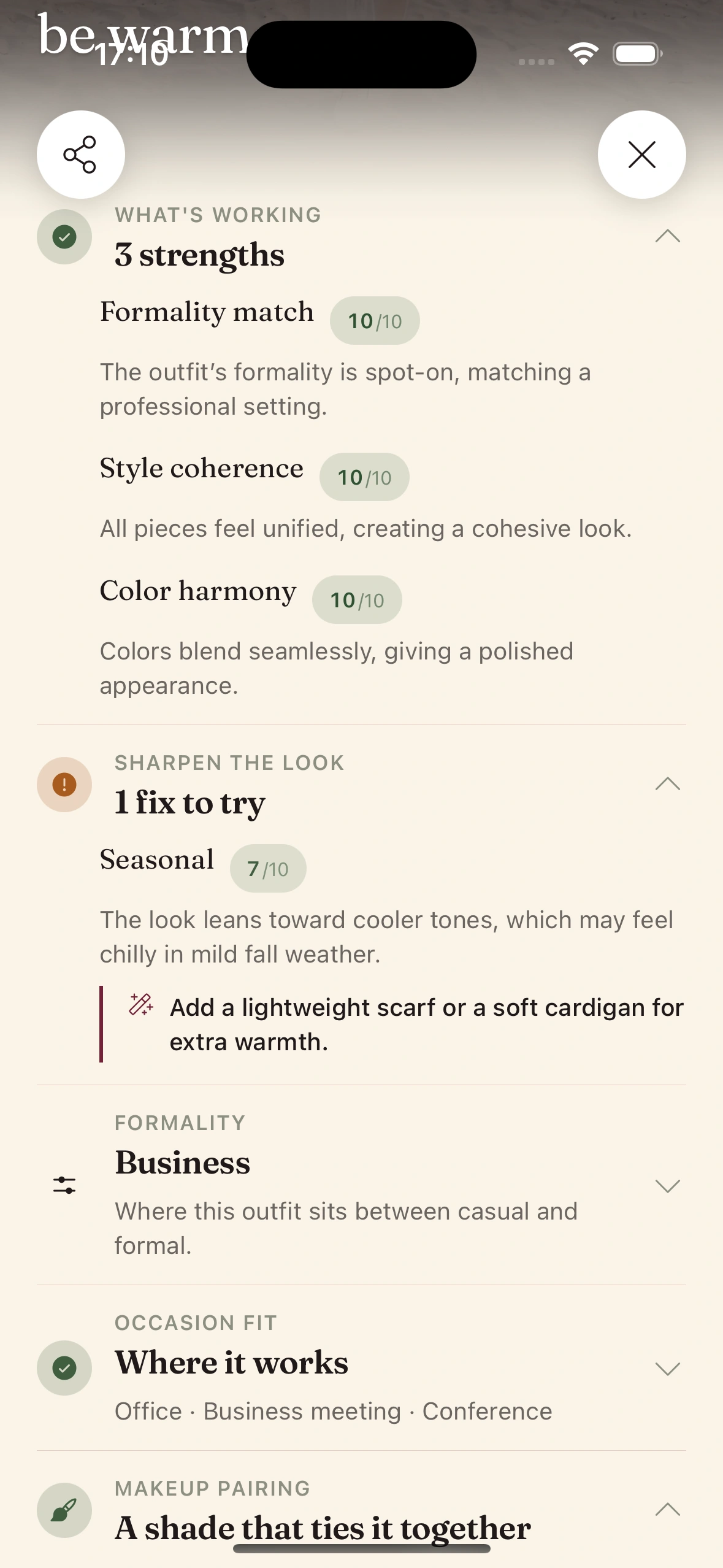
Build the look on the canvas, then check it with Rate My Outfit, which scores it on seven dimensions, formality match among them, and lists the occasions it suits. It also scores a mirror selfie of the outfit you're actually wearing.
Plan the interview day's outfit ahead in the Calendar. If you're tempted to buy something new for it, see it on you first with virtual try-on, and let Should I Buy check it against what you already own.
What it can't do: Clottr doesn't know the company's dress code. Its formality tags and scores reflect general style conventions, so deciding which step the company sits at is up to you. Clottr is coming soon: join the waitlist for early access.
Sources
Willis and Todorov (2006), Psychological Science: trait judgments from faces seen for a tenth of a second.
Howlett, Pine, Orakçıoğlu and Fletcher (2013), Journal of Fashion Marketing and Management: first impressions of a made-to-measure and an off-the-peg suit.
Barrick, Swider and Stewart (2010), Journal of Applied Psychology: early impressions, final interview ratings and job offers.
Frieder, Van Iddekinge and Raymark (2016), Journal of Occupational and Organizational Psychology: how long interviewers take to reach a decision.
Slepian, Ferber, Gold and Rutchick (2015), Social Psychological and Personality Science: formal clothing and abstract thinking.
Kraus and Mendes (2014), Journal of Experimental Psychology: General: suits, sweatpants and negotiation results.
Adam and Galinsky (2012), Journal of Experimental Social Psychology: the original lab coat experiment.
Burns, Fox, Greenstein, Olbright and Montgomery (2019), Journal of Experimental Social Psychology: a preregistered replication that did not reproduce the lab coat effect.
McCarthy and Goffin (2004), Personnel Psychology: the five kinds of job interview anxiety.
Steinemann (2016), Air Quality, Atmosphere and Health: health effects reported from fragranced products in the US.
Let Clottr build it from your closet
Clottr reads the occasion and weather, assembles an appropriate outfit from clothes you already own, and shows it on you before you leave the house.
Frequently Asked Questions
Is there a free tool that rates my outfit?
Yes, on this page: upload a photo and get a verdict in about ten seconds, two a day, no sign-up.
What is the best thing to wear to a job interview?
An outfit one step dressier than what people at the company wear on an ordinary day, in solid or quietly patterned pieces that fit well. In most offices that means a blazer with tailored pants or a skirt, a shirt, blouse or fine knit, and leather shoes. Banks and law firms still expect a suit; tech startups, chinos and a collared shirt or a fine knit.
Is it better to overdress or underdress for an interview?
Overdress, slightly. One step above the everyday dress code reads as effort; dressing below it can read as not taking the meeting seriously. Two or more steps above it, like a three-piece suit at a startup, can look out of touch, so aim for one.
Can I wear jeans to a job interview?
Only where people wear jeans to work every day, as at many tech, creative and startup companies, and then dark, plain, well-fitting jeans with a collared shirt or a fine knit and a blazer or overshirt. Anywhere with a business casual or formal dress code, wear chinos or tailored pants instead.
Do I need to wear a suit to a job interview?
In finance, law, consulting and other places where people wear suits every day, yes. In most other offices a blazer with tailored pants or a skirt is enough, and at many startups a suit is more than the room expects. If you're not sure, ask the recruiter what people wear to interviews.
What colors should I wear to a job interview?
Navy, charcoal, gray, white, light blue and other quiet colors work in any industry and keep the attention on what you say. There's no solid evidence that a particular color gets people hired, so wear colors you look and feel good in, and keep a bright color to one piece.
What should I wear to a video interview?
The same outfit you'd wear in person, shoes and pants included, in case you need to stand up. Pick solid mid-tone colors, avoid fine stripes and small checks that shimmer on camera, keep jewelry quiet, and test the outfit, the light and the background the day before.
What should I wear to a tech interview?
Usually smart casual: clean chinos or dark, plain jeans, a collared shirt, knit polo or fine sweater, and loafers or clean leather sneakers. Add an unstructured blazer at a larger company or for a client-facing role. A full suit is rarely expected.
How can I plan an interview outfit the night before?
Try on the full outfit with the shoes, sit down in it, and check the forecast for your commute. Then steam, polish and lay everything out, bag included. In Clottr you can plan that day's outfit ahead in the Calendar and check the look with Rate My Outfit.
Plan the interview outfit tonight, not at 7am.
Join early. Discounted for life.